Automating Machine Learning Workflows Using GitHub Actions
A practical guide explaining how GitHub Actions can automate Machine Learning workflows. This post covers CI/CD for ML, automated training, testing, and deployment pipelines.

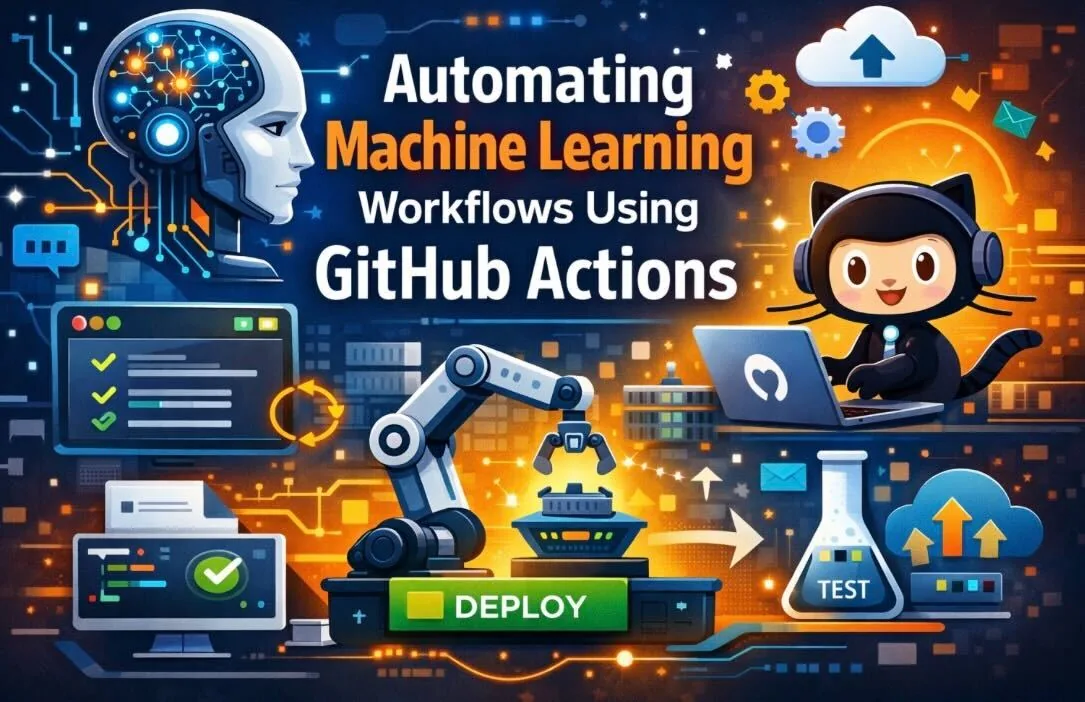
Modern Machine Learning systems are no longer limited to simply building models. In real-world production environments, machine learning projects require proper automation, version control, continuous testing, and reliable deployment pipelines. Managing these processes manually can quickly become inefficient and error-prone.
To address these challenges, developers adopt CI/CD pipelines and MLOps practices. These approaches bring automation and operational discipline to machine learning workflows. One powerful tool that enables this automation directly inside GitHub repositories is GitHub Actions.
GitHub Actions allows developers to create automated workflows that execute tasks such as testing, building, training, and deploying machine learning models whenever changes are pushed to the repository.
Understanding CI/CD
CI/CD stands for Continuous Integration and Continuous Deployment (or Continuous Delivery). It is a DevOps practice that automates the process of integrating code changes, testing them, and deploying them to production environments.
Continuous Integration (CI)
Continuous Integration focuses on automatically integrating code changes into a shared repository. Each time developers push changes, automated pipelines perform tasks such as:
Building the application Running automated tests Checking code quality Validating dependencies
This ensures that new changes do not break the existing system.
Continuous Deployment (CD)
Continuous Deployment automates the process of releasing applications to production after successful testing. Once the CI pipeline passes, the system automatically deploys the application or model.
Benefits of CI/CD include:
Faster development cycles Early detection of errors Improved collaboration between developers Reliable and repeatable deployments
What is MLOps?
Machine Learning Operations (MLOps) extends DevOps practices into machine learning workflows.
In traditional software engineering, CI/CD pipelines manage application builds and deployments. However, machine learning systems require additional processes such as:
Data validation Model training Model evaluation Experiment tracking Model deployment
MLOps introduces automation into these stages, ensuring that machine learning models can be developed, tested, and deployed consistently.
Role of GitHub Actions in Machine Learning
GitHub Actions is a built-in automation platform within GitHub that allows developers to define workflows using YAML configuration files.
These workflows automatically run when certain events occur in the repository, such as:
Code pushes Pull requests Scheduled tasks Manual triggers
For machine learning projects, GitHub Actions can automate several processes including:
Installing dependencies Running training scripts Evaluating models Generating reports Deploying trained models
This helps teams build fully automated ML pipelines.
Structure of a GitHub Actions Workflow
A GitHub Actions workflow is made up of several important components.
Workflow
A workflow is a set of automated steps defined in a YAML file inside the .github/workflows directory.
Example location:
.github/workflows/ml_pipeline.yml
The workflow defines when and how automation should run.
Events
Events trigger workflows. Common events include:
push
pull_request
schedule
workflow_dispatch
For example, a workflow may start whenever new code is pushed to the repository.
Jobs
Jobs are groups of tasks executed on runners. Each workflow can contain multiple jobs that run either sequentially or in parallel.
Steps
Steps are individual commands inside jobs. These commands may:
Install dependencies Run Python scripts Execute model training Perform evaluations
Runners
Runners are the servers where workflows execute. GitHub provides hosted runners such as:
Ubuntu Windows macOS
Developers can also configure self-hosted runners for specialized hardware like GPUs.
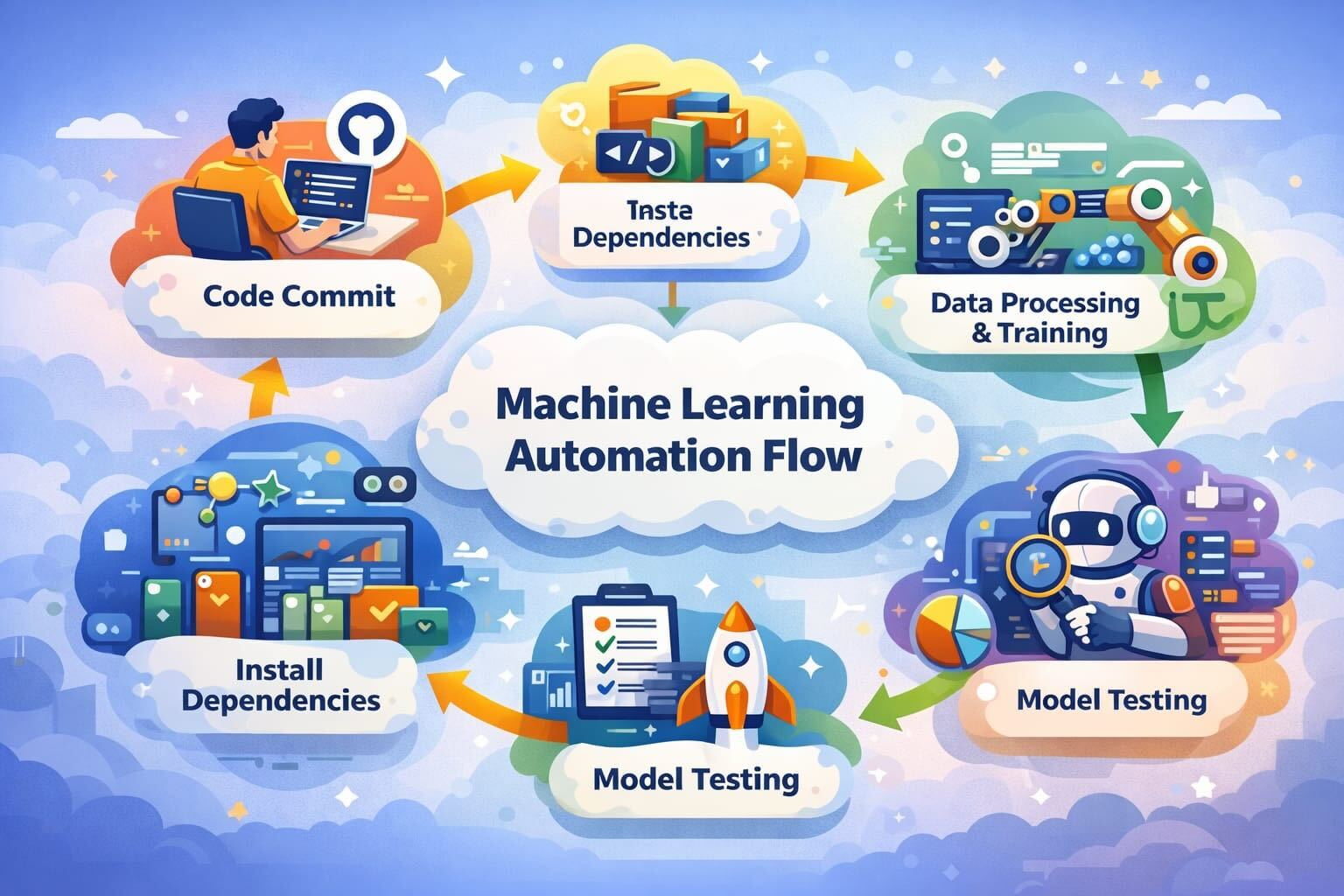
Machine Learning Automation Flow
Machine learning workflows consist of several stages that can be automated using CI/CD pipelines.
<img src={require('./img/auto3.jpg').default} alt="Machine Learning CI CD Flowchart" width="750" />
Typical automated ML workflow:
Code Commit Developers push code updates to the repository.
Install Dependencies Required libraries and packages are installed automatically.
Data Processing and Training Training scripts run to build or retrain machine learning models.
Model Testing Automated tests validate the model's functionality and performance.
Model Evaluation Metrics such as accuracy, precision, or recall are evaluated.
Deploy Model The trained model is deployed to production or cloud services.
Automation ensures that these steps occur consistently whenever updates are made.
Example GitHub Actions Workflow
Below is a simplified GitHub Actions workflow for a machine learning pipeline.
name: ML Pipeline
on: [push]
jobs:
train-model:
runs-on: ubuntu-latest
steps:
name: Checkout Repository
uses: actions/checkout@v3
name: Setup Python
uses: actions/setup-python@v4
with:
python-version: 3.9
name: Install Dependencies
run: pip install -r requirements.txt
name: Train Model
run: python train.py
name: Evaluate Model
run: python evaluate.py
This workflow automatically runs whenever new code is pushed to the repository.
Advantages of Automating ML Workflows
Automation provides several benefits for machine learning teams.
Reproducibility
Automation ensures that experiments run in the same environment every time.
Faster Development
Developers can test and deploy models quickly without manual intervention.
Collaboration
Teams can collaborate more effectively by using version control and shared workflows.
Scalability
Automated pipelines allow machine learning systems to scale easily across teams and environments.
Error Reduction
Automation reduces human errors and improves reliability.
Challenges in ML CI/CD
Although automation improves workflows, some challenges remain.
Large Dataset Management
Machine learning datasets can be extremely large, making it difficult to process them within CI pipelines.
Training Time
Complex models may require GPUs and long training durations.
Infrastructure Requirements
Production ML systems often require cloud infrastructure and monitoring systems.
Despite these challenges, automation tools continue evolving to support machine learning workflows.
Best Practices for ML Pipelines
<img src={require('./img/auto4.jpg').default} alt="Machine Learning" width="750" /> To build efficient machine learning pipelines, teams should follow best practices such as:
Version control datasets and models Use modular training scripts Track experiments and metrics Automate testing and evaluation Monitor deployed models
Following these practices ensures reliable and maintainable machine learning systems.
Conclusion
Automation is becoming an essential part of modern machine learning development. By integrating GitHub Actions into machine learning workflows, developers can build automated pipelines that handle training, testing, evaluation, and deployment.
This integration enables teams to adopt MLOps practices, improving efficiency, collaboration, and scalability.
GitHub Actions provides a flexible and powerful platform for implementing CI/CD pipelines directly within repositories, making it an ideal solution for automating machine learning workflows.
Deploy on Nife
Ready to deploy? Check out the Nife documentation:
From the team at Nife
Deploy your next app in minutes, not days.
Nife is a multi-cloud edge platform that lets you deploy, scale, and manage applications globally without the infrastructure headache.